


Tumor necrosis factor (TNF) is a major mediator of apoptosis as well as inflammation and immunity, and it has been implicated in the pathogenesis of a wide spectrum of human diseases, including sepsis, diabetes, cancer, osteoporosis, multiple sclerosis, rheumatoid arthritis, and inflammatory bowel diseases.
TNF-α is a 17-kDa protein consisting of 157 amino acids that is a homotrimer in solution. In humans, the gene is mapped to chromosome 6. Its bioactivity is mainly regulated by soluble TNF-α–binding receptors. TNF-α is mainly produced by activated macrophages, T lymphocytes, and natural killer cells. Lower expression is known for a variety of other cells, including fibroblasts, smooth muscle cells, and tumor cells. In cells, TNF-α is synthesized as pro-TNF (26 kDa), which is membrane-bound and is released upon cleavage of its pro domain by TNF-converting enzyme (TACE).
Many of the TNF-induced cellular responses are mediated by either one of the two TNF receptors, TNF-R1 and TNF-R2, both of which belong to the TNF receptor super-family. In response to TNF treatment, the transcription factor NF-κB and MAP kinases, including ERK, p38 and JNK, are activated in most types of cells and, in some cases, apoptosis or necrosis could also be induced. However, induction of apoptosis or necrosis is mainly achieved through TNFR1, which is also known as a death receptor. Activation of the NF-κB and MAPKs plays an important role in the induction of many cytokines and immune-regulatory proteins and is pivotal for many inflammatory responses.
| Cat. No. | Product Name | CAS No. | Purity | Chemical Structure |
|---|---|---|---|---|
| KM8848 |
(Rac)-Benpyrine
(Rac)-Benpyrine,Benpyrine 的外消旋体,是一种有效的具有口服活性的 TNF-α 抑制剂。(Rac)-Benpyrine 可用于 TNF-α 介导的炎症和自身免疫性疾病的研究。 |
1333714-43-4 | 98% |

|
| KE7633 | 1-(4-chloro-3-(trifluoromethyl)phenyl)-3-(7-(1-methyl-1H-pyrazol-4-yl)-2,3,4,9-tetrahydro-1H-carbazol-3-yl)urea | 2379727-88-3 | ≥95% |

|
| KE5163 | 11-Hydroxytephrosin | 72458-85-6 | ≥95% |

|
| KM32459 | 2141-V11 | 2923542-55-4 |

|
|
| KE7044 | 3,5-Dicaffeoyl-epi-quinic acid | 879305-14-3 | ≥95% |

|
| KE6718 | 7-O-Methylmorroniside | 119943-46-3 | ≥95% |

|
| KE4485 | 8alpha-Hydroxyhirsutinolide | 1394156-45-6 | ≥95% |

|
| KM36777 | Abiprubart | 2765071-95-0 | 99% |

|
| KM33406 | Acimtamig | 2738880-26-5 | 97% |

|
| KM17155 |
Adalimumab
Adalimumab 是一种人源的单克隆 IgG1 抗体,靶向肿瘤坏死因子α (TNF-α)。 |
331731-18-1 | 98% |

|
| KM37795 | Afelimomab | 156227-98-4 | 99% |

|
| KM32063 | Aplitabart | 2796349-94-3 |

|
|
| KM6475 |
Apratastat
Apratastat 是一种口服活性,有效且可逆的肿瘤坏死因子-α 转换酶 TACE 和基质金属蛋白酶 MMPs 的双重抑制剂。Apratastat 可以在体外,离体和体内有效抑制 TNF-α 的释放,体外和离体的 IC50 分别为 144 ng/mL和 81.7 ng/mL。 |
287405-51-0 | 98% |

|
| KM2800 |
Apremilast
Apremilast (CC-10004) 是一种口服有效的磷酸二酯酶 4 (PDE4) 抑制剂,IC50 为 74 nM。Apremilast 抑制脂多糖 (LPS) 释放 TNF-α,IC50 为 104 nM。 |
608141-41-9 | 98% |

|
| KM11185 |
Apremilast D5
Apremilast D5 (CC-10004 D5) 是一种 Apremilast 氘代物。Apremilast (CC-10004) 是一种口服有效的磷酸二酯酶 4 (PDE4) 抑制剂,IC50 为 74 nM。Apremilast 抑制脂多糖 (LPS) 释放 TNF-α,IC50 为 104 nM。 |
1258597-47-5 | 98% |

|
| KE5311 | Arteannuin N | 207446-92-2 | ≥95% |

|
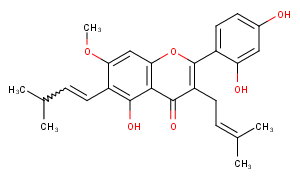
| KE6884 | Artocarpin | 7608-44-8 | ≥95% |
|
| KM19196 |
Astilbin
Astilbin 是一种黄酮类化合物,可增强 NRF2 活化。Astilbin 还抑制 TNF-α 表达和 NF-κB 活化。 |
29838-67-3 | 98% |

|
| KM37430 | Asunercept | 1450882-18-4 | 98% |

|
| KM39085 | Atenastobart | 2817644-49-6 |

|


关注我们
获得KKL MED 最新资讯


咨询热线:
400-881-9290
